Beyond the Gauge: Scrutinising Post-Repair Inspections (PRI) and the Role of Paint Measurement
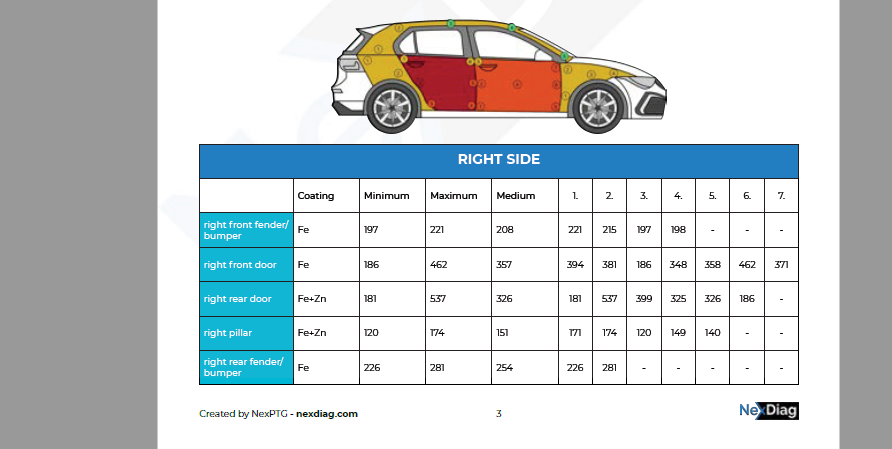
In the landscape of not-at-fault recovery and diminished value claims, the Post-Repair Inspection (PRI) has become a vital tool for accident management companies and solicitors. As legal teams seek to prove that a vehicle has not been returned to its pre-accident condition, technical evidence regarding paint quality and thickness is often the “smoking gun.”
The use of precision instruments like the Nextdiag paint thickness gauge has become industry standard for identifying substandard repairs. However, for a solicitor or recovery agent, a simple numerical reading is only the beginning. To withstand the scrutiny of insurer-led defense and provide a defensible quantum of loss, one must understand how to interpret these readings within a broader forensic context.
Here is how to scrutinise a PRI that utilises paint measurement and why the “human expert” remains the most critical component.
1. Identifying “Body Filler” vs. Quality Metalwork
The primary utility of a Nextdiag device in a PRI is identifying excessive coating thickness, which usually indicates the use of polyester body filler (bondo) rather than proper panel beating or replacement.
The Legal Angle: If a repairer was paid to replace a panel but instead “filled and skimmed” it, this constitutes both a breach of contract and a significant factor in diminished value.
The Scrutiny: A high micron reading (e.g., 500+ microns) is clear evidence of repair rather than replacement. However, an expert assessor must be able to testify whether that thickness is “within tolerance” for a specific manufacturer’s repair method or if it represents a structural compromise.
2. The ADAS Complication: When Paint Becomes a Safety Risk
Modern vehicles are equipped with Advanced Driver Assistance Systems (ADAS), including blind-spot monitors and parking sensors located behind bumper covers.
The Technical Risk: Manufacturers (such as BMW, Tesla, and Toyota) have strict “paint thickness budgets” for plastic components. If a repairer applies too many layers of base coat or clear coat, the radar signals can be attenuated or blocked entirely.
The Scrutiny: A PRI that only measures thickness on metal panels misses the safety-critical measurement of plastic covers. At OA Motor Assessing, we scrutinise the paint depth on sensor-adjacent areas to ensure the vehicle’s safety systems are still functional—a major leverage point in litigation.
3. Surface Texture and “Orange Peel” Match
Paint thickness (microns) is a measurement of quantity, not quality. A panel can have the “correct” thickness according to a Nextdiag gauge but still fail a Post-Repair Inspection due to poor “Orange Peel” matching or “Dry Spray.”
The Legal Angle: To return a client to their pre-accident position, the aesthetic finish must be indistinguishable from the factory finish.
The Scrutiny: We look for “mapping” (where the edges of the repair show through the paint over time) and texture mismatches. For a solicitor, these aesthetic failures are the primary drivers of Stigma Loss (Diminished Value), as they are the first things a professional car buyer or dealer will notice.
4. Distinguishing Factory Variance from Repair Defects
A common defense from insurers is that “factory paint thickness varies.” While true—robotic painting in factories can result in thinner coverage on inner pillars versus outer panels—there are established “Standard Deviations.”
The Scrutiny: A solicitor should never rely on a PRI that provides a single measurement. A robust assessment from OA Motor Assessing involves “comparative profiling.” we measure undamaged factory panels on the same vehicle to establish a baseline before identifying anomalies on the repaired sections. This eliminates the “factory variance” defense.
The OA Motor Assessing Advantage in Litigation
For accident management companies and solicitors, a Nextdiag gauge is a useful tool, but it is not an expert witness. A paint reading without a qualified interpretation is just a number; in court, it can be easily challenged.
OA Motor Assessing provides the forensic narrative that turns a paint measurement into a successful claim. Our Post-Repair Inspections provide:
Forensic Reporting: We translate micron readings into a technical argument regarding repair integrity and manufacturer compliance.
Diminished Value Calculation: We use paint data to quantify exactly how much the vehicle’s market value has dropped due to the repair history.
Safety Certification: We identify where excessive paint thickness may have compromised ADAS sensors, providing a high-priority safety argument for your claim.
Expert Credibility: Our assessors provide the professional weight necessary to defeat “in-house” insurer adjusters who may try to dismiss paint defects as “purely cosmetic.”
Are you handling a claim where the repair quality is in question?
Don’t rely on guesswork. Instruct OA Motor Assessing for a comprehensive Post-Repair Inspection. We provide the technical evidence you need to prove the loss and secure the quantum your client deserves.