Loss of Value After an Accident: Why You Need a Diminished Value Report to Claim Your Missing Money
You’ve been involved in a not-at-fault car accident. You went through the hassle of dealing with insurance, you organized a hire car, and finally, your vehicle is back from the smash repairs. It looks shiny, the panel gaps line up, and it drives perfectly.
The insurance company closes the claim, and you assume you’ve been fully compensated.
But have you?
If you decide to sell or trade-in that car tomorrow, you are legally and ethically obligated to disclose its accident history. What do you think happens next? The dealership or private buyer will immediately drop their offer. Why? Because a car that has been in a major crash is inherently worth less than an identical car with a clean history.
This hidden financial hit is called Diminished Value (DV), or Loss of Value. And if you don’t actively claim it from the at-fault party’s insurer, you are the one left paying the price.
Here is everything Australian drivers need to know about car depreciation after an accident, and how an Independent Diminished Value Report can help you recover your missing money.
What is Diminished Value?
In the Australian automotive market, a vehicle’s history matters. Buyers frequently check the PPSR (Personal Property Securities Register) and request accident histories.
Diminished Value is the difference in your car’s market value before the accident compared to its market value after the smash repairs are completed.
Even if the panel beaters did a flawless, factory-standard job, your vehicle now carries a “stigma.” Used car buyers prefer vehicles that haven’t had major structural repairs, repainting, or replaced airbags. Because of this market hesitation, your car will sell for less. That loss of profit is a direct result of the accident.
Can You Make a Diminished Value Claim in Australia?
Yes, but there is a catch you need to understand.
Typically, you cannot claim diminished value through your own comprehensive car insurance policy if you were at fault. Your policy contract usually only covers the cost of repairs to return the car to a safe, drivable condition.
However, if you were in a not-at-fault accident, the rules change. Under Australian common law, you are entitled to be put back in the exact financial position you were in before the crash. This means you can pursue a third-party property damage claim against the at-fault driver (and their insurer) for the loss of value your asset has suffered.
The Problem: Insurers Won’t Hand Over the Money Voluntarily
If you call the at-fault driver’s insurance company and say, “Hey, my car is worth $5,000 less now, please pay me,” they will politely decline.
Insurance companies are businesses designed to minimize payouts. They will argue that the car was repaired to industry standards and therefore, no loss has occurred. To beat this argument, you cannot rely on guesswork, Redbook printouts, or a verbal quote from a used car salesman.
You need hard, irrefutable evidence. You need a Diminished Value Report.
What is a Diminished Value Report?
A Diminished Value Report is a formal, legally recognized document prepared by an Independent Motor Vehicle Assessor. It serves as expert evidence to prove exactly how much value your car has lost.
Here is what an expert from OA Motor Assessing will do when preparing your report:
- Pre-Accident Valuation: We determine the exact market value of your vehicle milliseconds before the crash, factoring in your specific kilometres, condition, and aftermarket accessories.
- Repair Analysis: We review the smash repair invoices and assess the severity of the damage. (Did it involve structural chassis damage? Were airbags deployed? Was major welding required?)
- Post-Repair Valuation: We calculate the current market value of the vehicle, applying a mathematically sound “stigma” deduction based on live Australian market data and dealer trade-in matrices.
- The Quantum: We provide a finalized, expert calculation of the exact dollar amount you are owed for the diminished value.
How This Report Helps You Win Your Claim
When you submit an independent Diminished Value Report from OA Motor Assessing to the at-fault insurer, you change the game.
You are no longer a frustrated driver making a subjective complaint; you are a consumer armed with a professional, expert-witness-level document. This report is designed to withstand the scrutiny of insurance adjusters, Internal Dispute Resolution (IDR) teams, and even the Australian Financial Complaints Authority (AFCA) or the Magistrates Court.
It forces the insurer to address the financial reality of the accident, resulting in a higher likelihood of a successful payout to cover your loss.
Don’t Pay for Someone Else’s Mistake
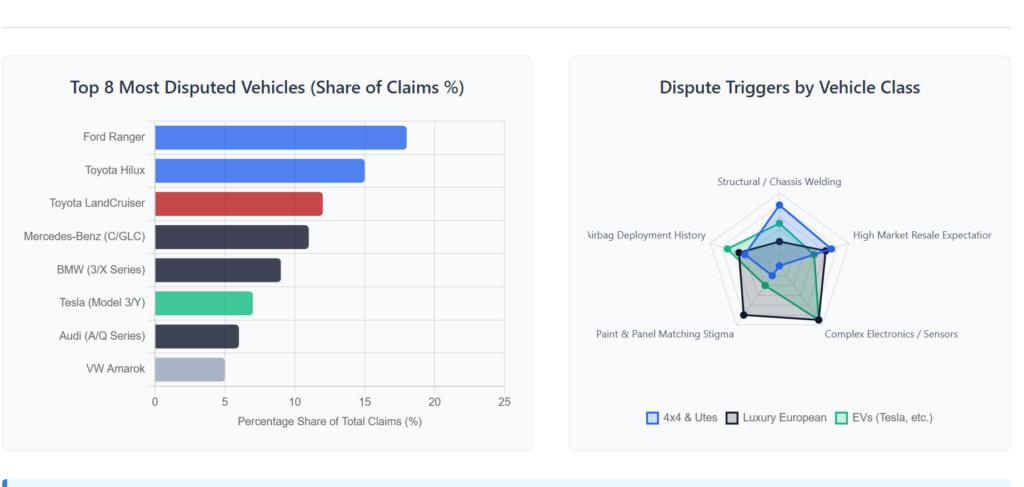
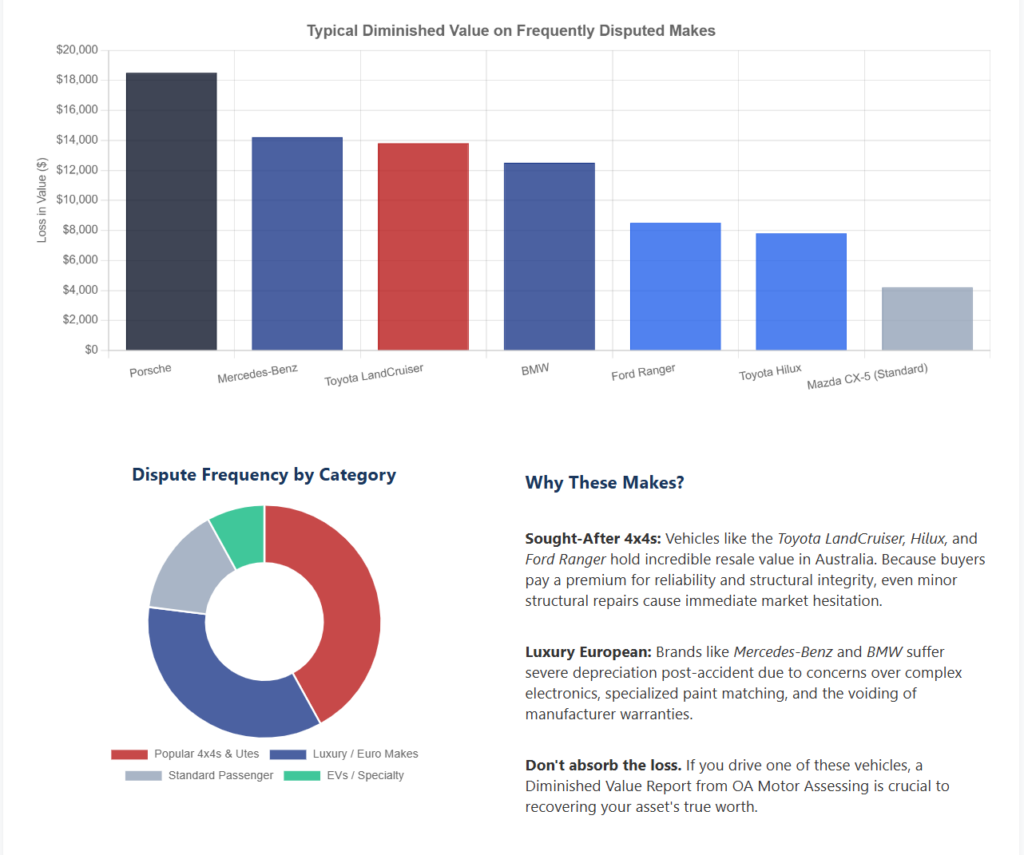
If you own a relatively new vehicle, a luxury car, or a highly sought-after 4×4 (like a Ranger, Hilux, or LandCruiser), a major accident can strip $5,000 to $15,000+ off its resale value overnight.
If you weren’t at fault, you shouldn’t have to absorb that loss.
Before you close your claim, get the evidence you need to recover your maximum compensation. Contact OA Motor Assessing today to find out if you qualify for a Diminished Value claim and let our expert independent assessors fight for the money you are owed.